Pennie Carnes, LPC, CSAT
Shadows of the Cross: A Christian Companion to Facing the Shadow
Craig Cashwell, Pennie Johnson & Patrick Carnes
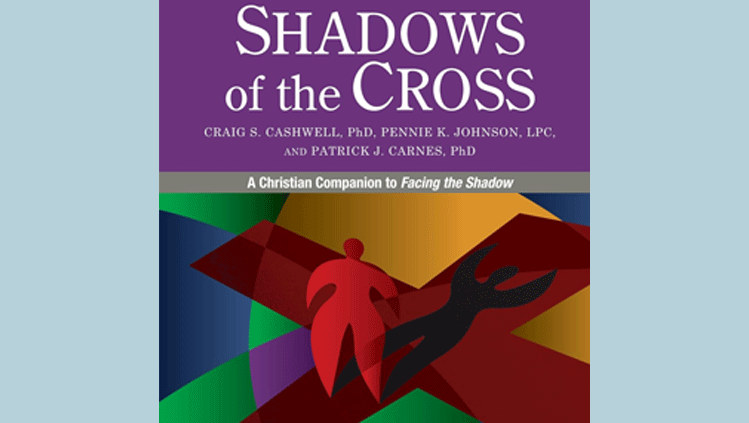
Sex addiction among people of faith is often described as “the secret sin of the church.” As long as it remains hidden in the dark, hope for recovery can feel painfully out of reach. I am honored to have co-authored Shadows of the Cross: A Christian Companion to Facing the Shadow. Through this book, many men and women have found the courage to step into the light and break free from the bondage of problematic sexual behaviors.
Shadows of the Cross
A Christian Companion to Facing the Shadow
By Craig Cashwell, Pennie Johnson & Patrick Carnes
Question and Answer Session
1.
Q: How would you describe this book in 140 characters or less?
A. Shadows of the Cross offers a companion book to Facing the Shadows that focuses on the spiritual aspects of recovery from sex addiction.
2.
Q: I see this book is a companion to Facing the Shadow. Could you explain how best to use the books together?
A: Shadows of the Cross was written as a Christian companion workbook to Facing the Shadow – Dr. Patrick Carnes’ classic workbook on sexual addiction recovery.
Facing the Shadows is the most widely used workbook for treating sexual addiction by both clinical and non-clinical settings and in treatment centers. However, many who come to treatment also bring along their shame as a Christian who is also an addict. Often, these addicts struggle to understand and accept the psychological aspects of recovery without a Christian framework.
Many exercises and readings in Shadows of the Cross include Facing the Shadows as a necessary activity, along with prayer and journaling. For example, the first three chapters of Shadows of the Cross lay the foundation of understanding sex addiction, the importance of spiritual disciplines and outlines where Jesus is in the Twelve Steps. Beginning in Chapter Four, the authors clearly state that to gain the most benefit of the chapter, the reader must first read Chapter One in Facing the Shadows, plus do the activities. That is, Shadows of the Cross is written as a companion to Facing the Shadows, with explicit cross-references to the work in Facing the Shadows.
3.
Q: You describe Christians who struggle with sex addiction as living the ultimate “Jekyll and Hyde” existence. Could you explain that?
A: In Step One, addicts must first surrender to their understanding that their lives have become unmanageable and out of control. This act of acceptance can also be found in the book of Romans “I do not understand what I do. For what I want to do I do not do, but what I hate to I do…For I have the desire to do what is good, but I cannot carry it out” (Romans 7:15, 18b; NIV)
Robert Lewis Stevenson wrote Dr. Jekyll and Mr. Hyde as a tale describing the inner turmoil people go through when they have compartmentalized their lives. Commonly, this is an apt characterization of the individual who publicly participates in a church, but privately experiences great shame over addictive sexual behavior.
4.
Q: Who would benefit from Shadows of the Cross?
A: The beneficiaries of the book are numerous and include Christian men and women who are sex addicts beginning their recovery journey, and therapists and clergy who work with sex addicts.
5.
Q: How can the Bible be used to help people recover from sex addiction?
A: The Bible provides tremendous guidance to the recovery process. For example, Twelve-step work is supported by scripture. Additionally, the psychological and spiritual struggles of many biblical characters offers direction for recovery. We used ten of Jesus’ parables throughout the book and wrote modern day versions of the parables as a way to reach people through Biblical characters to whom they can relate.
6.
Q: What spiritual practices can be used to help the recovery process?
A: The idea that a daily spiritual practice supports recovery was introduced by Bill W. and Dr. Bob when they created the original Twelve Steps. Step Eleven says, “Sought through prayer and meditation to improve our conscious contact with God as we understood God, praying only for knowledge and God’s will of us and the power to carry that out.”
There are many spiritual practices that support recovery, including diverse types of prayer, Christian meditation, and acts of service to others. These spiritual practices are discussed in detail in Shadows of the Cross, including directions on how to start an intentional spiritual practice and how to use spiritual practice both as a daily part of recovery and during particularly challenging times in the recovery process.
7.
Q: How can different types of prayer be used to help in recovery?
A: Prayer is the most common spiritual practice within Christian communities and with good reason. Prayer invokes a personal dialogue with God and is a powerful spiritual practice. It is this personal encounter with God that is at the heart of spiritual disciplines. However, just as we are all unique in our personal understanding of God so are the ways we feel most connected to God. Shadows of the Cross offers instructional guidance through nine types of prayer. Many Christians participate primarily in two types of prayer, petitionary and intercessory. While these are two vital types of prayer, in Shadows of the Cross we take the perspective that the recovering addict is supported best by broadening her or his variety of prayer.
8.
Q: Shadows of the Cross emphasizes the importance of disclosure in successful recovery. What role can churches play in helping people recover from sex addiction?
A: In recovery, there is an adage that “we are as sick as our secrets”, an adage that encourages honesty with self and others, including disclosure to trusted companions. Ideally, this could include disclosure to a pastor and others within the religious community. Unfortunately, however, there are many instances of disclosure within the religious community that end poorly for the recovering addict. In some instances, this includes shaming or being asked to leave the religious community, severing vital relationships and supports.
Accordingly, in Shadows of the Cross, we encourage disclosure, but also discernment about when and to whom to disclose. Additionally, we discuss the importance of understanding sex addiction as a brain disease to avoid the shaming that happens, at times, within religious communities.
We can provide workshops, presentation and consultation for spiritual leaders, lay counselors and the members of the Church in the effort to train them in what is sex addiction, how to help the sufferer and their families along with knowing what they can do to effectively connect with the addict on spiritual matters. Isn’t this what Jesus did throughout his years of teaching and doing miracles; love those that others cast away?
9.
Q: What specific challenges do people who self-identify as Christians have when struggling with sex addiction than others in the general population?
A: Addicts, in general, carry the guilt of disappointing their families and friends. There are moments of despair and times they mentally torture themselves with memories of the path of destruction they left behind as a consequence of their actions in active addictions. A Christian sex addict has the additional, and sometimes, ultimate feeling of shame that they have let down their God; the God whom they vowed to love, adore and whose Holy guidance would be the only way they would live their life in all situation. However, we all are sinners and we fall short of carrying out God’s instructions to the highest degree. A person suffering with sex addiction carries the additional shame of disgracing their bodies and minds in the search for something or someone other than God to fulfil their cravings and desire to be connected and loved by others.
Additionally, there are those who argue that sex addiction is not real, that it is, in fact, an orchestration of the mental health field. One argument is that mental health professionals promulgate the sex addiction concept by pathologizing high sexual desire. Such arguments, however, fly in the face of best practices in mental health services, which argue that therapists work with behaviors that are inconsistent with client values and belief systems. That is, these critics of the sex addiction concept argue that it is the values, beliefs, and morals that are the problem, not the sexual behaviors. For the Christian client, however, these beliefs, values, and morals are grounded in scripture and the teachings of Jesus.
This book supports the sex addict to join their spiritual traditions in a healthy way. It is also the first in a series of Facing the Shadow companions book to be used for people in other religious practices.
10.
Q: Is Shadows of the Cross compatible with the Twelve Steps?
A: Yes, and we have dedicated an entire chapter (Chapter 3 – Jesus and the Twelve Steps) to explain how to align the Twelve Steps Program into the teachings of Jesus. Appendix A in the book contains a chart comparing the Twelve Steps, related Biblical text and the principles applicable to each Step. In addition, the authors have included Twelve Steps practice throughout their writings in Shadows of the Cross. In Shadows of the Cross, we give attention to the Twelve Steps recovery groups as an avenue for the recovering addict to experience strength, hope and the spirit of safety within a healthy community.